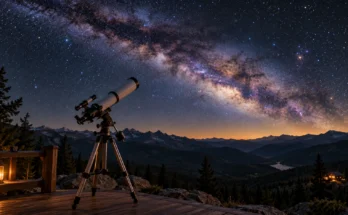
When we look up at the night sky, we see stars scattered across a vast darkness. Most appear as tiny points of light, but many have planets of their own orbiting far beyond our solar system.
These distant worlds are called exoplanets. Some are rocky and relatively small, while others are enormous gas giants. Some orbit so close to their stars that a year lasts only a few days. Others travel through colder, more distant regions of their planetary systems.
Finding these worlds is an impressive accomplishment. Most exoplanets are too small and faint to see directly beside the bright stars they orbit. Instead, astronomers often discover them by watching for subtle changes in a star’s light or motion.
Some discoveries raise an especially exciting question: Could a distant planet have conditions suitable for life? To understand what scientists mean when they describe a world as “potentially habitable,” we first need to look at what exoplanets are and how we find them.
What Is an Exoplanet?
An exoplanet, short for extrasolar planet, is a planet beyond our solar system. Most of the exoplanets we know about orbit stars other than the Sun.
Our solar system contains eight planets, from Mercury to Neptune. Together with their moons, asteroids, comets, and other objects, they orbit our Sun. An exoplanet belongs to a different planetary system, often centered on a star many light-years away.
A light-year is the distance light travels in one year, not a measurement of time. Even Proxima Centauri b, the closest known exoplanet to Earth, is more than four light-years away. That makes it a nearby neighbor by astronomical standards, but an extraordinarily distant destination for us. NASA Science
Astronomers have confirmed thousands of exoplanets, and many more possible planets are being investigated. Their discoveries show that planets are common throughout our galaxy and that planetary systems can look very different from our own.
What Kinds of Exoplanets Have We Found?
Exoplanets come in a surprising variety of sizes and environments. Some have familiar characteristics, while others have no close equivalent among the planets in our solar system.
Rocky Planets
Rocky planets are made largely of solid materials such as rock and metal. Earth, Mars, Venus, and Mercury are examples in our solar system.
Astronomers have found exoplanets close to Earth’s size that may also be rocky. Size alone, however, does not tell us everything about a planet. A world roughly as large as Earth could have a very different atmosphere, surface temperature, and history.
Gas Giants and Hot Jupiters
Some exoplanets are giant planets similar in broad terms to Jupiter or Saturn. A number of these orbit extremely close to their stars and are known as hot Jupiters.
These planets are especially interesting because the giant planets in our solar system orbit much farther from the Sun. Finding large planets close to other stars has helped scientists reconsider how planetary systems form and change over time.
Super-Earths and Other Larger Worlds
A super-Earth is generally a planet more massive than Earth but less massive than Neptune. The name describes its size or mass range; it does not mean the planet is necessarily Earth-like or more suitable for life.
Depending on the planet, a super-Earth might be rocky or have a substantial atmosphere. Scientists often need additional observations before they can make confident statements about its composition.
There are also planets between Earth and Neptune in size that may have thick atmospheres and environments unlike those of any planet in our solar system. Together, these discoveries remind us that the eight planets around our Sun represent only part of the variety of worlds that may exist.
Why Are Exoplanets So Difficult to See?
If planets are common, why can’t we simply point a telescope at a distant star and see them?
The main problem is the difference in brightness. Stars produce their own light, while planets are much dimmer and usually appear very close to their stars from our point of view. The star’s glare can overwhelm the faint light coming from the planet.
Distance makes the problem even harder. A planet that is enormous compared with Earth can still appear incredibly small when it is many light-years away. For most known exoplanets, astronomers have therefore relied on indirect evidence: the planet’s effect on the light or movement of its star.
It helps to think of these methods as ways of finding clues. Astronomers collect measurements, compare possible explanations, and conduct follow-up observations before confirming that a signal comes from a planet.
How Do Astronomers Find Exoplanets?
Scientists use several methods to discover distant planets. The two most widely used are the transit method and the radial velocity method. NASA Science
The Transit Method: Watching a Star Dim
A transit happens when a planet passes between its star and an observer. From our perspective, the planet crosses the face of the star and blocks a small amount of its light.
Imagine watching a bright lamp from a distance. If a small object passes in front of it, the light reaching your eyes briefly decreases. The effect is subtle when the object is a planet crossing a distant star, but sensitive instruments can measure it.
If astronomers see a star dim at regular intervals, an orbiting planet may be responsible. The time between dips helps them estimate how long the planet takes to orbit its star. The amount of dimming can also help them estimate the planet’s size compared with the star.
There is a catch: the planet’s orbit must be aligned so that it crosses in front of the star from our viewpoint. Many planets will never produce a visible transit from Earth, even though they are present.
NASA’s Kepler Space Telescope used this method to discover thousands of worlds. The Transiting Exoplanet Survey Satellite, known as TESS, was designed to search for planets around bright, relatively nearby stars. NASA Science
The Radial Velocity Method: Detecting a Star’s Wobble
A star’s gravity holds a planet in orbit, but the planet also pulls on the star. This gravitational interaction causes the star to move slightly as the two bodies travel around their shared center of mass.
Astronomers can detect some of that motion by studying the star’s light. As the star moves toward us, its light shifts slightly toward shorter, bluer wavelengths. As it moves away, the light shifts toward longer, redder wavelengths. These tiny changes are known as Doppler shifts.
A repeating pattern can reveal the gravitational pull of an orbiting planet. This approach is called the radial velocity method, and it can provide information about a planet’s orbit and mass.
Sometimes astronomers use transit and radial velocity observations together. A transit can help reveal a planet’s size, while radial velocity measurements can help estimate its mass. With both, scientists can calculate an average density and begin to investigate whether the planet is likely to be rocky or gas-rich. NASA Science
Direct Imaging: Seeing a Planet’s Light
In some cases, astronomers can capture images of exoplanets directly. To do this, they use specialized instruments and techniques that reduce or block the overwhelming light of the host star.
Direct imaging is difficult, and the resulting image generally does not show a detailed landscape. Instead, an exoplanet may appear as a small point of light. Still, that light can give scientists valuable information about the planet.
The planets most accessible to this method tend to be large, relatively young, and far enough from their stars for instruments to separate their light from the star’s glare.
Gravitational Microlensing: Using Gravity as a Lens
Another technique uses an effect predicted by Einstein’s theory of gravity. When one star passes nearly in front of a more distant star from our point of view, the foreground star’s gravity can bend and magnify the background star’s light.
If a planet orbits the foreground star, it may produce an additional feature in the changing light. Astronomers can study that signal for evidence of a planet.
This method, called gravitational microlensing, can reveal planets in regions that are difficult to explore with other techniques. These alignments are often brief, however, and may not repeat in a way that allows easy follow-up. NASA Science
What Does “Potentially Habitable” Mean?
When a newly discovered exoplanet makes headlines, it may be described as potentially habitable or located in its star’s habitable zone.
The habitable zone is the region around a star where temperatures could allow liquid water to exist on the surface of a planet, given suitable atmospheric conditions. Because liquid water is essential to life as we know it, scientists use this region as a useful starting point when choosing planets for further study. NASA Science
The location of that zone depends on the star. A cooler, dimmer star has a habitable zone closer in, while a hotter, brighter star has a habitable zone farther out.
Being in the habitable zone does not prove that a planet has liquid water, a breathable atmosphere, or life. It means the planet’s distance from its star makes surface liquid water a possibility worth investigating.
That distinction matters. A planet might lie in the right region but lack an atmosphere, have an atmosphere that makes its surface too hot, or be exposed to intense radiation from its star. Its size, composition, and history could also affect whether conditions are suitable for life.
Even within our own solar system, Earth shows how much more there is to consider than distance alone. Its atmosphere, water, and other characteristics all contribute to the conditions we experience. Finding an Earth-sized world in a promising orbit is an exciting first step, but it is not the same as finding another Earth.
NASA makes an important distinction between a planet that could support life and one that is actually inhabited. Evidence for either requires much more investigation than simply identifying a planet in a habitable zone. NASA Science
Can We Tell What an Exoplanet’s Atmosphere Contains?
In some cases, yes. Scientists can study an exoplanet’s atmosphere by examining how it interacts with light.
During a transit, a small amount of starlight may pass through the edge of the planet’s atmosphere before reaching our telescopes. Different gases absorb light at different wavelengths, leaving patterns that astronomers can analyze.
The James Webb Space Telescope is one of the instruments helping scientists examine the atmospheres of distant worlds. Depending on the planet and the quality of the observations, researchers may look for evidence of molecules such as water vapor, carbon dioxide, or methane.
Interpreting those signals can be challenging. An apparent feature in the data must be checked carefully, and the presence of a particular molecule does not automatically mean life is present. Scientists must also consider other explanations, including processes that do not involve living organisms. NASA Science
Have We Found Life on an Exoplanet?
No life has been confirmed on an exoplanet.
Astronomers have identified intriguing worlds and studied some of their atmospheres, but a promising planet and a confirmed discovery of life are very different things. The search continues by identifying planets, learning about their environments, and improving the tools needed to investigate them.
That work is valuable even when a planet turns out to be very different from Earth. Every discovery helps scientists understand how planets form, how atmospheres behave, and how our solar system fits into the larger picture.
Can You See an Exoplanet With a Backyard Telescope?
For most backyard stargazers, seeing an exoplanet directly is not a realistic expectation. The planets are too distant and faint, and their host stars are much brighter.
You can, however, observe stars that host known exoplanets. When you find one of those stars in the night sky, you are looking toward another planetary system—even though its planets remain hidden from view.
Some experienced amateur astronomers also contribute to exoplanet research by measuring subtle changes in a star’s brightness during a predicted transit. NASA’s Exoplanet Watch offers opportunities to learn about this kind of observing and data analysis.
For a different way to explore, NASA’s Eyes on Exoplanets lets you travel through a digital representation of known planetary systems. It is a useful place to compare distant worlds and get a sense of how widely they vary. NASA Science
A Universe Full of Other Worlds
Exoplanets have changed the way we look at the night sky. The stars above us are not simply distant points of light; many are suns with planets of their own.
By measuring tiny dips in starlight, detecting a star’s motion, and using other creative techniques, astronomers have found worlds that would otherwise remain hidden. Some are unlike anything in our solar system, while others offer clues about how common rocky planets might be.
The search for potentially habitable planets continues, but there is still much we do not know. For now, each discovery gives us another opportunity to ask better questions about planets, stars, and the remarkable variety of worlds beyond our own.